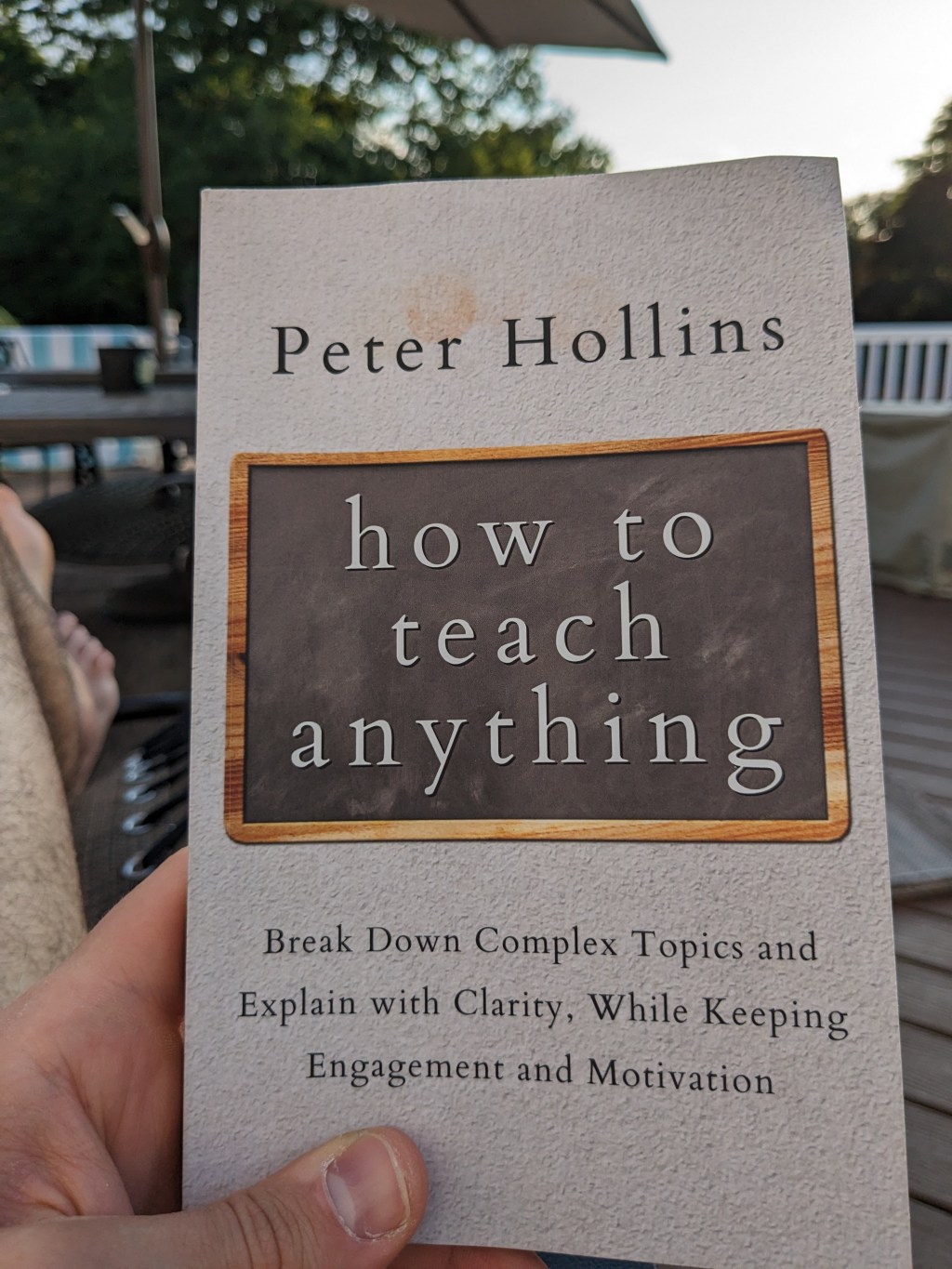
Interestingly enough, I was given this book as a gift during the first semester of college I was teaching. If only I had this book a little sooner, I felt that I could have put some of these methods into practice. What was surprising to me, was how as a student I had practiced these methods both in college and in my job when dealing with a new subject or problem. Peter Hollins, describes and cites a lot of sources throughout the book using trials of students to comprehend information. Not surprisingly enough, just reading to read without a goal, being provided notes, and just being lectured at were some of the ways that students were unable to retain any information.
My main takeaway from the book came from the methods described in the latter half of the book where the different types of teaching were elaborated on for students. Things like problem based teaching with minimal instruction, or allowing for open minded learning, and letting failure be apart of the learning process were some of the best ways to comprehend a new topic. Peter described different ways to utilize these approaches from the teacher and student perspective which was a great touch in the book. Leveraging failure as a part of the learning process is crucial, but also how students can use failure as a step to learning, and how as a teacher you should learn to introduce failure. One of the more common approaches is the sandwich method, where you give a compliment followed by some constructive feedback to work on, and then another positive compliment. This way the student or person feels like they are making progress towards their goal.
I am happy to think that throughout most of my time as a student and teacher, I actually used these methods without ever knowing it. From the ways that Peter Hollins talks about best practices for taking notes, ways to teach a new subject, or questioning yourself enough to really evaluate if you know a subject well enough to teach it to someone else.
Whether your an educator, teacher, or manager I think you can benefit from this book. It’s less about teaching or learning in a traditional classroom setting, and more about how to comprehend new ideas or to figure out a problem. Peter does a great job talking to the reader as both the educator and the student. There was always a new method or question that he asked the reader about that had me questioning if I really knew what I was even supposedly an expert in.
Not to mention at the end of the book as any good educator would do, there is a great summary breaking down the information from each chapter. I recommend for any business manager looking to improve team performance, or for the professor looking to better themselves in the classroom.
 Christopher Sandoli
Leave a comment